Module 6: Clinical Contexts
Module 6 of 7
What You Will Be Able to Do
- Draw the line between AI as a study aid for clinical reasoning and AI in actual patient care.
- Turn a real case into a teaching abstraction you can discuss freely, and explain why it makes the better exercise.
- Find out what a clinical site expects before you use AI there.
The Core Idea
The Four-Minute Version
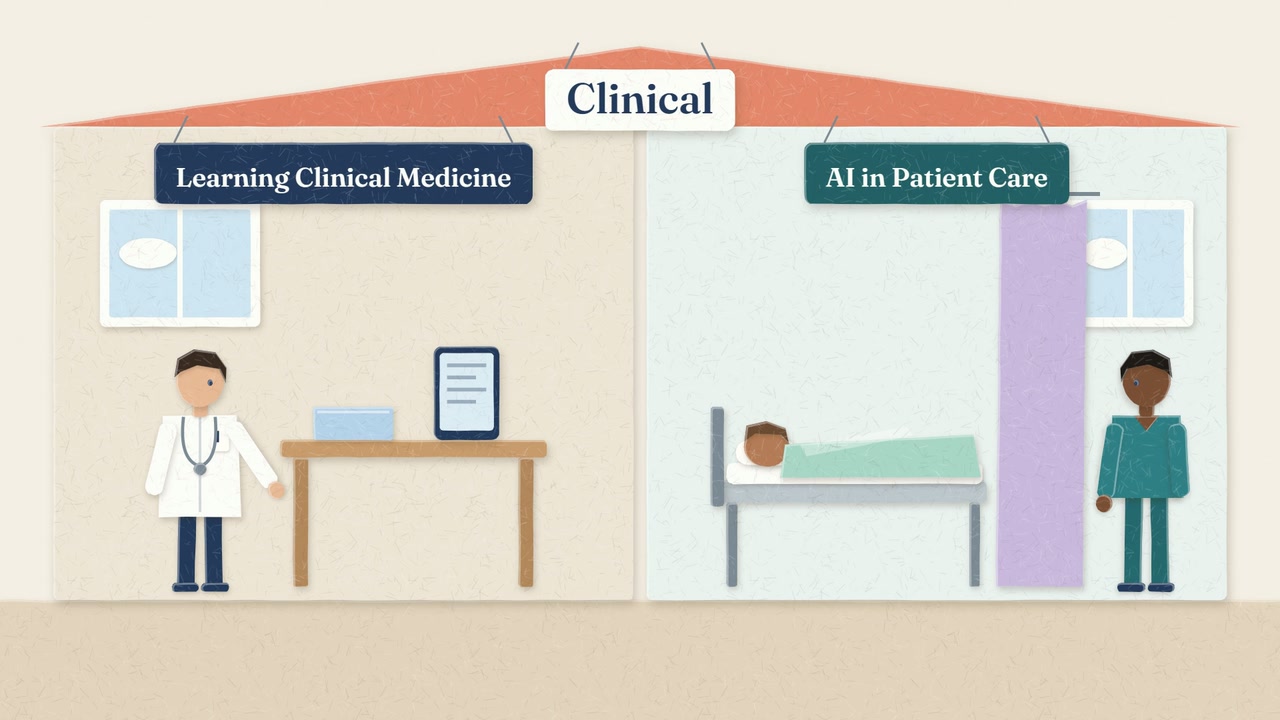
Two different kinds of work share the word "clinical," and each has its own expectations.
Learning Clinical Medicine with AI: Encouraged, with Discipline
Practicing differentials against an artificial intelligence (AI) case, asking for mechanism explanations, generating practice questions: these are legitimate and effective uses, and the Medical Learning tools section lists platforms built for exactly this. The discipline is remembering Module 1: fluent clinical-sounding text is not verified clinical knowledge. Check what it tells you against your course materials and the literature; the model is a practice partner, not a reference.
AI in Patient Care
In patient care, the reason for caution is the patient: a model has not examined them, cannot see what the chart leaves out, and carries none of the responsibility, which is why the AI Responsible Use Policy asks for extreme caution in clinical contexts (section E). AI can inform a clinical decision; it cannot own one. As a student, that means your supervisor's judgment about a real patient comes first. If an AI suggestion makes you question a plan, take the question to your supervisor; that is a good use of what the tool showed you.
Patient Information
A real case makes a good study prompt, and the version that works best with an AI is the teaching abstraction: an age band, a presentation pattern, the findings, and nothing that could identify the patient. A rare combination of details can identify someone as surely as a name, and a photo of a chart or a recording of an encounter carries as much as the chart itself. The pattern is what you are practicing on, and invented variations of it show you what changes the differential. The AI Responsible Use Policy is the reference for patient information. If practicing on a case raises something that could matter for that patient now, tell your supervising physician or the patient's nurse now, through your site's usual escalation route: the patient is the reason. And if patient details go into a tool by mistake, the AI Committee can help you work out next steps.
Two kinds of work share the word clinical
Learning clinical medicine
Encouraged, with discipline
- practice differentials on AI cases
- mechanism explanations
- generated practice questions
Checked against the literature.
AI in patient care
Informs the decision, never owns it
- the model has not examined the patient
- your supervisor's judgment comes first
Accountability stays human.
At Clinical Sites
Hospitals and clinics have their own AI policies, some covering specific tools (ambient scribes, documentation assistants) that the site has or has not sanctioned. On rotation, the site's policy applies alongside the university's, so a use has to fit both. Asking your supervisor what the site allows is the quickest way to find out, and it may turn up tools the site already provides.
Bias Is a Clinical Issue Here
Models reflect their training data, and documented performance gaps across populations make uncritical clinical use an equity problem, not just an accuracy one. That is why the policy's attention to bias matters most exactly here: checking a suggestion against the patient in front of you is part of the reasoning.
Self-Check
After a memorable encounter, you want to explore the differential with a chatbot tonight. What decides whether that is fine?
What you type in. A teaching abstraction (demographic band, presentation, findings pattern) is a legitimate and useful study exercise, and invented variations of it show you what changes the differential. Anything identifiable, including an unusual combination of details that could point to a real person, is patient information, and the policy is the reference for that.
A resident on your rotation uses a phone app to transcribe patient conversations and asks you to do the same. What governs your answer?
The clinical site's policy on that specific tool, together with the university's policy on patient information. If the site has sanctioned the app for patient encounters, the site's rules for it apply; if it has not, recording patients with it sends their information to a third party without their consent or the site's protections. Ask your supervisor which it is before you start.
An AI tool suggests a diagnosis your attending disagrees with. What does the policy say about whose call it is?
The clinician's. AI informs judgment; it does not arbitrate it. The tool's suggestion can prompt a question or a second look at the evidence, but clinical authority and accountability stay with the clinicians.
Going Deeper
Color key: ToolGuideBenchmark
- Medical Learning Tools The directory's category built for study and case practice.
- Image Generation Benchmarks Why general image models are not anatomy references.
- AI and the Residency Application What the Association of American Medical Colleges (AAMC) and the Educational Commission for Foreign Medical Graduates (ECFMG) permit, and how to tell a patient story in a personal statement without identifying the patient.
Content last reviewed September 26, 2026. Review dates are maintained as described on the About page.