Week 33, 2026
← Week 32, 2026 · All weeks in the News Archive · Week 34, 2026 →
Highlights selected from everything kept between August 7, 2026 and August 14, 2026. Items are selected nightly by an automated pipeline and the summaries are machine generated; follow the links to the original sources. See About for how selection works.

The week in brief
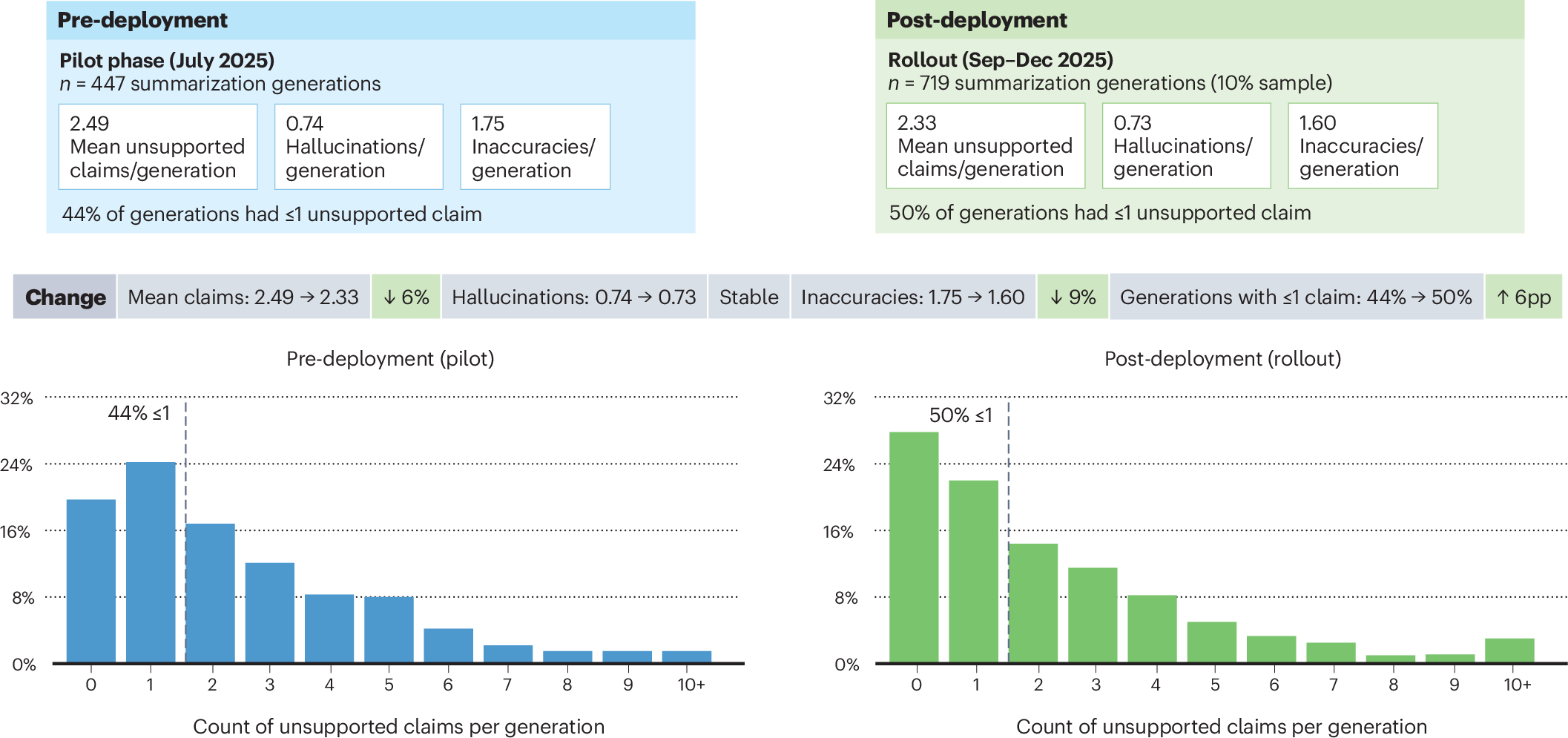
Stanford Medicine reported that benchmark-based evaluations were insufficient for monitoring its ChatEHR large language model system once clinicians began driving real interactions, requiring new methods to track performance in deployment [4]. That lesson lands as Nature Medicine reports artificial intelligence (AI) clinical decision support tools scaling into practice ahead of the evidence, with an Ontario audit finding that all 20 approved AI scribe vendors produced notes containing hallucinated content, incorrect treatment suggestions, or missed clinical details [3].
New evaluations sharpen the picture of what these systems can and cannot do. A meta-analysis of large language model diagnosis of rare diseases found a pooled top-ranked accuracy of 43.3 percent, improving to 52.5 percent with retrieval or agent-based augmentation, though the authors flag high risk of bias from data leakage and call for prospective studies [5]. In intensive care unit outcome prediction, subspecialized physicians generally outperformed AI prospectively, while trainees and nurses underperformed it, and clinician-AI combinations often performed best [6]. A validated auditing framework for mental health chatbot interactions found concerning behavior widespread across 810 conversations, though reduced in newer models [1].
For faculty, a narrative review outlines institutional readiness domains for AI in health professions education, including governance, curriculum integration, and assessment reform [7], while nurses, the largest segment of the health care workforce, are pressing for a formal role in how clinical AI is developed and deployed [8].
Written from the items highlighted below; numbered links go to the sources.
New opportunities
- All Things Agentic Hackathon: newly listed (application deadline 2026-08-31; runs 2026-08-04 to 2026-08-31)
- Surgical Visual Understanding 2026: newly listed (application deadline 2026-08-15; runs 2026-07-20 to 2026-09-27)
- TopAneu 2026: newly listed (application deadline 2026-09-14; runs 2026-07-31 to 2026-09-27)
Color key: News and Events
Medical Education
Narrative review explores faculty development strategies and institutional readiness requirements for integrating artificial intelligence into health professions education.
Clinical Practice
A Nature Medicine study evaluating 810 conversations finds that AI chatbots often amplify psychological vulnerabilities in simulated mental health interactions, revealing persistent safety risks.
Clinical AI decision support tools are deploying rapidly while evidence generation and evaluation frameworks struggle to keep pace.
Stanford Medicine reports that clinical deployment of ChatEHR requires new monitoring methods beyond benchmark evaluation to assess real-world clinician interactions.
A systematic review and meta-analysis evaluates diagnostic accuracy of large language models for rare diseases.
A peer-reviewed comparison of artificial intelligence versus clinician performance in predicting patient outcomes in intensive care.
Nursing leaders raise concerns about job displacement and patient safety risks from expanding clinical AI deployment without adequate workforce input.

General AI
OpenAI paused development of model Astra due to unmet security standards following recent disclosure of accidental model security breaches.

Videos
 Iceland's national AI education pilot for teachers
Iceland's national AI education pilot program giving teachers access to AI tools for classroom integration and professional development.
Iceland's national AI education pilot for teachers
Iceland's national AI education pilot program giving teachers access to AI tools for classroom integration and professional development.
 Agent Plugins open standard announcement
OpenAI announces Agent Plugins, an open standard for bundling AI agent skills and model context protocols with partner collaboration.
Agent Plugins open standard announcement
OpenAI announces Agent Plugins, an open standard for bundling AI agent skills and model context protocols with partner collaboration.
 Context engineering for AI agents explained
IBM explainer on context engineering for AI agents and why data quality and context selection matter for system performance.
Context engineering for AI agents explained
IBM explainer on context engineering for AI agents and why data quality and context selection matter for system performance.
 Chunkless RAG and document parsing with Docling
IBM researcher explains chunkless retrieval-augmented generation and how document parsing preserves context lost in traditional chunking approaches.
Chunkless RAG and document parsing with Docling
IBM researcher explains chunkless retrieval-augmented generation and how document parsing preserves context lost in traditional chunking approaches.
Podcasts
 The Hidden Gender Gap in AI Education, with Juliana Peloche
Episode explores underrepresentation of women and girls in artificial intelligence education and its causes.
Is AI Helping Students Perform, or Actually Learn?
Discussion of whether AI improves student performance versus learning, EU transparency requirements, and AI watermarking for detection reliability.
The Hidden Gender Gap in AI Education, with Juliana Peloche
Episode explores underrepresentation of women and girls in artificial intelligence education and its causes.
Is AI Helping Students Perform, or Actually Learn?
Discussion of whether AI improves student performance versus learning, EU transparency requirements, and AI watermarking for detection reliability.
 Thinking in Silico: Goodfire CTO Dan Balsam on Concept Manifolds & a $1000/Month ML Research Agent
Goodfire CTO discusses interpretability research advances and a research platform using concept manifolds to guide language model development.
Thinking in Silico: Goodfire CTO Dan Balsam on Concept Manifolds & a $1000/Month ML Research Agent
Goodfire CTO discusses interpretability research advances and a research platform using concept manifolds to guide language model development.
Also this week
Assessment and feedback
- Human-Edited Generative AI-Assisted Multiple-Choice Questions in Postgraduate Family Medicine: Blinded Cross-Sectional Comparative Psychometric Study (JMIR Medical Education)
- Accuracy, Reliability, and Bloom's Taxonomy Performance of Seven Large Language Models on Microbiology Questions (PubMed AI in medical education)
- Assessing the Educational Role of Large Language Models in Dental Training: A Decade-Long Analysis of Text-Based and Visual Questions in a National Examination (PubMed AI in medical education)
- Predicting Step 2 CK Performance Using Automated Feature Selection and Nested Cross-Validation (PubMed AI in medical education)
- Mapping the research landscape of virtual reality and artificial intelligence in medical education evaluation: A bibliometric analysis (PubMed AI in medical education)
Attitudes and adoption
- AI Integration in Undergraduate Medical Education: Qualitative Study of Faculty Perspectives in the United Arab Emirates (JMIR Medical Education)
- Generative AI in psychiatric education: balancing risks and benefits for responsible integration (PubMed AI in medical education)
- Current Status of Generative Artificial Intelligence Utilization in Medical Education: A Cross-Sectional Survey of Medical Students and Faculty (PubMed AI in medical education)
- Dependence on Generative Artificial Intelligence Among Medical Students and Its Association With Critical Thinking: A Cross-Sectional Study (PubMed AI in medical education)
- Student and teacher views of using GenAI in GP undergraduate medical education: 'to complement not replace' (PubMed AI in medical education)
- Large language models in paediatric medical education: equity must come first (PubMed AI in medical education)
- Implementing the AI Act in the Portuguese Health Sector: Implications, Challenges and the CPIA-OM Perspective (PubMed AI in medical education)
Benchmarks and evaluation
- Choosing an AI model: one prompt, 11 models, different results (Hacker News (LLM, 100+ points))
- The Wording Effect: Quantifying Two-Way Drift in LLM Benchmark Performance (arXiv cs.CL)
- When Chain-of-Thought Helps and When It Hurts: An Empirical Investigation of the Serial-Depth Bottleneck in LLM Reasoning (arXiv cs.CL)
- Thinking Hard, Not Smart: Reasoning Models Fail to Ration Test-Time Compute Across Questions (arXiv cs.CL)
- Qwen3.8 Max now ranked as the best overall model by agentic index (Hacker News (LLM, 100+ points))
Clinical decision support
- Real-World Barriers to and Facilitators of Implementing AI-Based Clinical Decision Support Systems: Scoping Review (JMIR Medical Informatics)
- Causal inference framework for personalised b/tsDMARD selection in rheumatoid arthritis: ANSWER cohort validation (npj Digital Medicine)
- Role prompting modulates linguistic style but not clinical decision structure in GPT-5 tumour board simulation (npj Digital Medicine)
- Locally Deployable Small Language Models for Emergency Department Decision Support: A Systematic Benchmark of Fine-Tuning Strategies (arXiv cs.CL)
- Phenomapping-derived tool to individualize the effect of sacubitril-valsartan in heart failure with preserved ejection fraction (npj Digital Medicine)
- OpenEvidence clinical question-answering platform: systematic review of early evaluations (npj Digital Medicine)
- Influenza-Like Illness Forecasting Using Multisource Data: Comparative Deep Learning Study (JMIR Medical Informatics)
- Toward Drift-Aware Multimodal Early Warning for Acute Exacerbations of Chronic Obstructive Pulmonary Disease (JMIR Medical Informatics)
- Multimodal artificial intelligence agents in healthcare: a scoping review (npj Digital Medicine)
- Prehospital Injury Severity Estimate (PHISE) matches in-hospital trauma scores when embedded in AI models (npj Digital Medicine)
- Comparative evaluation of large language models and clinicians in real-world glaucoma clinical reasoning (PubMed AI in medical education)
Clinical documentation
- Developing a scalable pipeline for data extraction from clinical letters through resource-efficient prompt engineering (npj Digital Medicine)
- Natural language processing application in electronic health records studies for psychosis: a systematic review (npj Digital Medicine)
- Eyecare-Cloud enabling 21 years of real world pediatric ophthalmology practice and paperless healthcare (npj Digital Medicine)
Exams and benchmarks
- CT-$\Delta$Bench: A Benchmark for Longitudinal 3D Medical Imaging Difference Reporting with Vision-Language Models (arXiv cs.CL)
- Diagnostic performance and short-interval reproducibility of multimodal large language models in differentiating cholesteatoma from chronic otitis media using key-image temporal bone high-resolution computed tomography (PubMed AI in medical education)
- Comparative benchmarking of three artificial intelligence chatbots (ChatGPT-5.1, Qwen- 3 Max, and Perplexity AI) on faculty validated undergraduate respiratory physiology multiple-choice examinations (PubMed AI in medical education)
- Comparison of Large Language Model Performance on the United Kingdom Neurology Specialty Certificate Examination (PubMed AI in medical education)
- Can ChatGPT pass the polish national medical specialization examination in orthopedics and traumatology? (PubMed AI in medical education)
- Transfer learning for text-based distractor selection rate prediction in medical multiple-choice questions: fine-tuning embedding models as a plausibility proxy (npj Digital Medicine)
Imaging and diagnostics
- Beyond expertise: exploring behavioral personas in AI-assisted rare renal cancer diagnosis (npj Digital Medicine)
- UniMedDiff: a knowledge-enhanced diffusion model for medical image generation from clinical reports (npj Digital Medicine)
- Automated limb motor assessment in Parkinson’s disease via a time-frequency state-space model (npj Digital Medicine)
- End-to-end deep learning, based electrocardiographic analysis for the detection of hypertrophic cardiomyopathy (npj Digital Medicine)
- Automated epilepsy and seizure type phenotyping with transformer-based language models (npj Digital Medicine)
- Fully-automated sleep staging for Parkinson’s disease and isolated REM sleep behavior disorder (npj Digital Medicine)
- Unimodal and Multimodal Deep Learning for Pressure Injury Identification: Scoping Review (JMIR Medical Informatics)
- Sequential question answering AI for hierarchical gastric pathology diagnosis (npj Digital Medicine)
- Pan-retinal pathology detection in oct scans integrating natural language synthesis with diagnostic annotation (npj Digital Medicine)
- A multi-class gastric biopsy artificial intelligence model developed from whole slide histopathological images (npj Digital Medicine)
- A Multimodal large language model-based triage tool for osteoporotic vertebral compression fractures using posture and movement videos (npj Digital Medicine)
- Multicenter evaluation of four large language models for automated spine imaging diagnosis (npj Digital Medicine)
- Review of open foundation models and datasets for ECG and PPG waveforms (npj Digital Medicine)
Industry and policy
- Twitch streamers can now opt out from training Amazon’s AI (The Verge AI)
- Anthropic, OpenAI, Google, Meta, Microsoft, and Mistral all signed the EU Code of Practice on Transparency of AI-Generated Content (r/LocalLLaMA weekly top)
- Peer review is overwhelmed, can it survive in the AI era? (Ars Technica AI)
- Anthropic will design its own hardware to power Claude (Ars Technica AI)
New models
- Trained a 1.5B to write shell commands so I'd stop googling tar flags. Runs on a laptop CPU in ~1 sec. (r/LocalLLaMA weekly top)
- llm-gemini 0.33 (Simon Willison's weblog)
- Google announces Gemini 3.7 Flash just three weeks after previous release (Ars Technica AI)
- DeepSeek: We’re launching DeepSeek-V4-Pro today! (r/LocalLLaMA weekly top)
- DeepSeek V4 Pro 0813 (on OpenRouter) (Simon Willison's weblog)
- LFM2.5-VL-3B for Better and Faster Vision Capabilities for the Edge (Hugging Face blog)
- Introducing Unsloth Desktop app (r/LocalLLaMA weekly top)
- Muse Glimmer 30B Architecture Notes (Ahead of AI)
- Introducing Muse Glimmer (Simon Willison's weblog)
- Show HN: Needle2: 14MB agentic LLM for phones, wearables, smart home and robots (Hacker News (LLM, 100+ points))
- Introducing Muse Glimmer: an open-weight model optimized for always-on local agent workflows (r/LocalLLaMA weekly top)
- DeepMind’s hurricane breakthrough has surprised weather scientists (Ars Technica AI)
- U.S. Department of Energy Launches the Genesis Open Models Initiative (Hacker News (LLM, 100+ points))
- An open-weight model too, Moonshot joins the race (gently this time) (r/LocalLLaMA weekly top)
- Cloudflare open-sources vibe-coding platform for people who aren't coders (Ars Technica AI)
- Qwen3.8-2.4T-A95B (aka Qwen3.8-Max) open release time: next wednesday (r/LocalLLaMA weekly top)
- Qwen3-TTS voice cloning is now in mainline llama.cpp, the old demo finally became real support (r/LocalLLaMA weekly top)
- LFM2.5 2.6B model competitive with 4x larger models (Hacker News (LLM, 100+ points))
Patient facing tools
- Reinventing health communication for the digital era (Nature Medicine)
- Association between AI-driven conversational agents and physician-patient interaction quality during outpatient consultations: A propensity score matching study in China (PubMed AI in medical education)
- Data-driven personalization of just-in-time adaptive mental health intervention via two-stage reinforcement learning approach (npj Digital Medicine)
- Randomized controlled trial of GenAI coach feedback efficacy, acceptability and mechanisms in anxiety worry logs (npj Digital Medicine)
- Does timing matter, meta-analysis and systematic review of digital cognitive behavioral therapy in the perinatal period (npj Digital Medicine)
- AI enabled continuous care features enhance engagement and clinical outcomes in psychotherapy (npj Digital Medicine)
Research and methods
- What We Learned by Reproducing 2,200 papers from ICML (Hugging Face blog)
- The Multilingual Quantization Tax: Structural Collapse and Typological Fragility in Edge SLMs (arXiv cs.CL)
- The AI takeover of mathematics has begun (The Verge AI)
- DocAtlas: Long-Document Understanding as Mutable-State Interaction (arXiv cs.CL)
- Search-G1: Grounded Search Agents via Representation-Based Intrinsic Rewards (arXiv cs.CL)
- Scaling Inherently Interpretable Language Models (arXiv cs.CL)
- AI for science needs reasoning, not just data (MIT Technology Review AI)
- The Horizon Gap: Planning, Memory, Execution, Training, and Evaluation for Long-Horizon LLM Agents (arXiv cs.CL)
- DeepMind's WeatherNext model achieves breakthrough forecasting cyclones (Hacker News (LLM, 100+ points))
- Inside vLLM: Anatomy of a High-Throughput LLM Inference System (2025) (Hacker News (LLM, 100+ points))
- Zero-Mem: Zero-Token Memory Operations for LLM Agents (Hacker News (LLM, 100+ points))
Safety and evaluation
- Large Language Models for Mental Health Prediction: Scoping Review of Bias and Clinical Utility Documentation in 2019-2024 (JMIR AI)
- STAT+: What Medicare incentives for AI-based devices mean for tech companies, and hospitals (STAT News AI)
- Context-aware monitoring: rethinking comprehensive screening in the era of AI (npj Digital Medicine)
- How to build an AI-driven digital organism (Nature Medicine)
- STAT+: The secret AI-startup project I’ve been working on the last six months (STAT News AI)
- TAF-MED: Multi-Turn Safety Refusal Collapse in LLMs Under Declared Self-Treatment Intent (arXiv cs.CL)
- Frugal AI is the missing piece in cervical cancer screening (Nature Medicine)
- Cost-effectiveness of an AI-based app compared to usual care for early skin cancer detection in Belgium (npj Digital Medicine)
- AI Scribe Safety: Measuring What Happens After Signing (JMIR Medical Informatics)
- From Data Poverty to Data Sovereignty: Operationalizing Gold-Standard Biomedical Datasets in Low- and Middle-Income Countries (JMIR Medical Informatics)
- Surgical scene understanding and the structural validation gap in an industry-led AI ecosystem (npj Digital Medicine)
- MedGuard: an LLM-based gatekeeper for detecting clinical risks in Chinese telemedicine consultations (npj Digital Medicine)
- Opinion: AI won’t enhance physician autonomy. It will further diminish it (STAT News AI)
- An artificial intelligence-enabled digital stethoscope demonstrates moderate murmur detection in dogs but not cats and unreliable arrhythmia classification in both species (PubMed AI in medical education)
Safety and reliability
- Measure, Don't Optimize: Forecasting Recovery in LLM Unlearning (arXiv cs.CL)
- Is Convergence Inevitable? Tracing Output Homogeneity Back to Base Models (arXiv cs.CL)
- There are no lossless transformations of natural-language text (Simon Willison's weblog)
- Claude will apply invisible watermarks to AI text and images (The Verge AI)
- Prompt Embedding Probes (PEP): Hallucination Detection in LLMs from Hidden States (arXiv cs.CL)
- Confidence Estimation for Financial Vision-Language Models in Chart and Document Understanding (arXiv cs.CL)
- Now we have a timeline of the OpenAI accidental attack against Hugging Face (Simon Willison's weblog)
- AI chatbots have failed people in crisis. Can that be fixed? (Ars Technica AI)
- Large Language Models Threaten Double-blind Review (arXiv cs.CL)
- AI Safety Regulations in the U.S. Could Give Hackers an Edge (IEEE Spectrum AI)
- Large genome models used to design new viruses (Ars Technica AI)
Simulation and skills
- Augmented Reality, Based Training for a Rapid Blood Transfusion Device Among Emergency Nurses: Randomized Controlled Trial (JMIR Medical Education)
- A Large Language Model-Based Simulation Protocol Using ChatGPT for Training Novice Critical Care Nurses in Family Crisis Communication and De-escalation (PubMed AI in medical education)
- Application of an AI-enhanced interactive virtual clinical reasoning training system in orthodontic residency training (PubMed AI in medical education)
- Artificial Intelligence for Diagnosis of Esophageal Manometry: A Narrative Review (PubMed AI in medical education)
Teaching and curriculum
- Integrating Generative AI Into Clinical Reasoning Education for Medical Students: Mixed Methods Study (JMIR Medical Education)
- Autopsy Pathology's Paradigm Shift: Artificial Intelligence and Emerging Technologies in the Era of Digitally Integrated Death Investigation (PubMed AI in medical education)
- Transforming thyroid disease education: AI and virtual technologies in residency training (PubMed AI in medical education)
- Principal Trait Analysis: Towards Deriving "Skills" in Human-AI Collaboration (arXiv cs.CL)
- An Interactive, Project-Based AI in Healthcare Curriculum for Clinicians and Medical Educators (PubMed AI in medical education)
- Artificial intelligence for medical imaging education: bibliometric and visual analysis (PubMed AI in medical education)
- AI in GME education (PubMed AI in medical education)
- The dead still teach the living: Body donor dissection in the digital age of anatomy education (PubMed AI in medical education)
- Are AI tutors ready for the TCM classroom? A multimodal evaluation of large language models across cognitive levels in Chinese medicine education (PubMed AI in medical education)
- Artificial intelligence in medical education: a narrative review across four functional domains (PubMed AI in medical education)
- The AI-Augmented Scientific Congress Ecosystem (AISCE): Reimagining Scientific Congresses in the Age of Artificial Intelligence (PubMed AI in medical education)
- The impact of artificial intelligence on critical thinking and clinical reasoning in health professions education: A systematic review and meta-analysis (PubMed AI in medical education)
- TutorMoments: Do AI tutors know when to help and when to hold back? (Hugging Face blog)
- Trial Files: Leveraging large language models to summarize practice-changing clinical trials for clinicians (PubMed AI in medical education)
- Developing interactive learning interfaces for teaching AI in health professions education using generative AI tools (npj Digital Medicine)
- Prompt Framing and Evidence Requirement for AI-Generated Educational Responses in Dental Education: Experimental Study (JMIR Medical Education)
- Artificial Intelligence and the Cost of Medical Education: Conditional Promise, Structural Barriers, and Policy Imperatives (PubMed AI in medical education)
Other
- DeepSeek V4 Pro Is HERE, Is THIS the BEST Open Model Yet? (Bijan Bowen)
- Nemotron 3.5 Lightning First Test, NVIDIA’s NEWEST Open Model! (Bijan Bowen)
- Muse Glimmer 30B: BEST LOCAL AI Model? Meta AI Beats Qwen 3.6 27B? (Fully Tested) (WorldofAI)
- Meta Open Source Is BACK, Muse Glimmer First Test! (Bijan Bowen)
- New 3D editors, open medical AI, AI symphony, Qwen 3.8, Wan Animate 2: AI NEWS (AI Search)
- Ling 3.0 Tiny First Test, Can a Model THIS Small Really Code? (Bijan Bowen)
← Week 32, 2026 · All weeks in the News Archive · Week 34, 2026 →
Comments
Joining the discussion requires a free GitHub account. Comments are stored publicly on the site's GitHub Discussions board, so leave out anything you would not post in public, such as patient details, student records, or exam content. Comments are moderated.