Week 27, 2026
← Week 26, 2026 · All weeks in the News Archive · Week 28, 2026 →
Highlights selected from everything kept between June 26, 2026 and July 3, 2026. Items are selected nightly by an automated pipeline and link to their original sources. See About for how selection works.

The week in brief
A pragmatic, cluster-randomized trial in 16 primary care facilities in Kenya offers some of the first real-world evidence on large language models in low-resource clinical settings. Across 9,691 patients managed by 103 clinical officers, treatment failure within 14 days occurred in 2.2 percent of the group with LLM assistance and 2.0 percent of the control group, a difference that was not statistically significant [2]. The authors report that LLM assistance was safe, with no serious adverse events judged related to the intervention, but that any benefit, if present, is probably modest [2]. This tempers vignette-based comparisons that had suggested LLMs can match or exceed provider performance on some tasks [2].
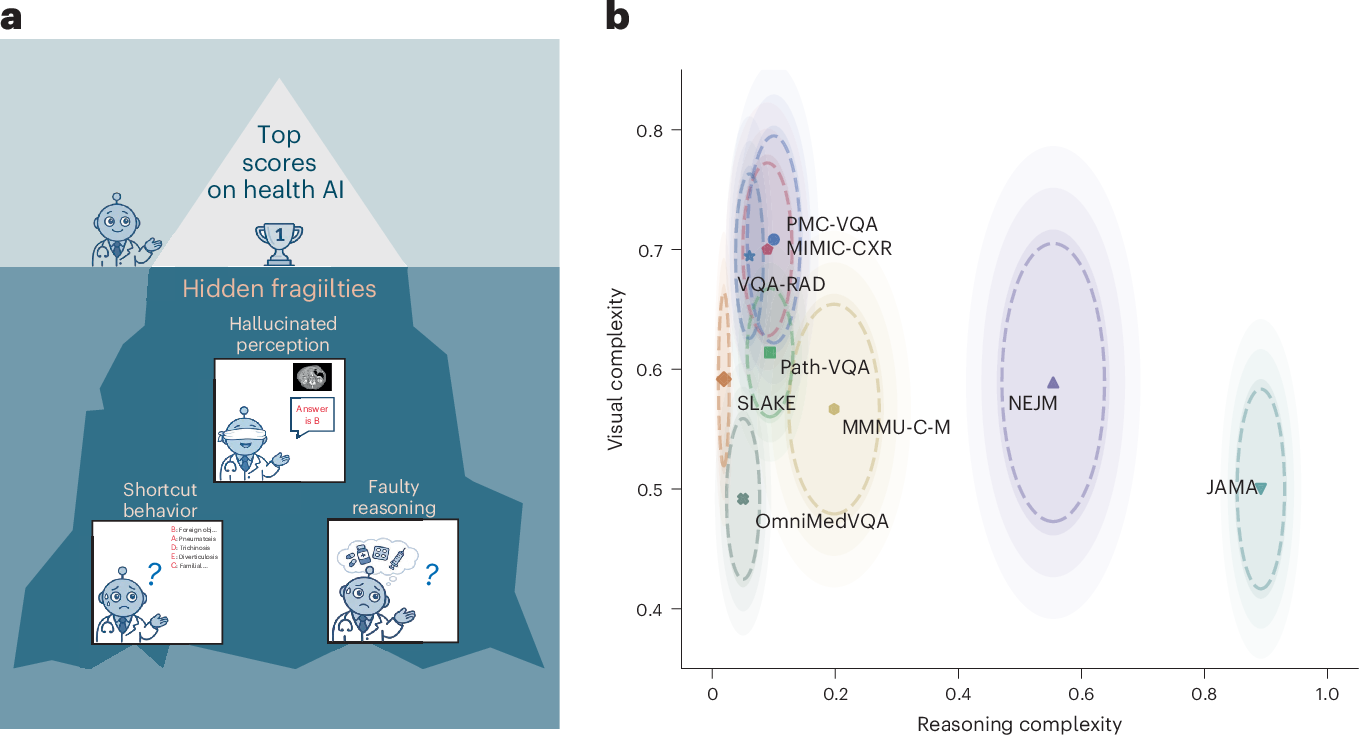
Several reports this coverage window converge on how models are evaluated. A stress-test study of frontier models such as GPT-5 and Gemini found prevalent brittleness: systems could guess correct answers with key inputs removed yet be confused by minor prompt changes while producing convincing but flawed reasoning traces [3]. An accompanying summary argues that high benchmark scores do not establish readiness for medical decision support or patient-facing use [5]. In authentic oncology notes, GPT-4 produced reasoning errors in 23.1 percent of interpretations, often reflecting cognitive bias patterns; GPT-5.1 reduced error rates but retained the same structured failure patterns [7].
For educators, agent-based systems show measured progress: HemaGuide reported 82.8 percent concordance in a prospective silent trial and hallucinations in 0.3 percent of evaluated cases [4], while agents such as AMIE and MIRA target multi-step clinical problems [1]. A scoping review documents accelerating AI use in undergraduate clinical skills curricula since 2022 [6], and a pilot randomized trial tested prompt-guided virtual microscopy in a histology module [8].
Written from the items highlighted below; numbered links go to the sources.
Conference calendar updates
- ASU+GSV Summit 2027: added to the calendar (2027-04-04 to 2027-04-07, San Diego, California, USA)
Color key: News and Events
Medical Education
Scoping review finds AI implementation in clinical skills education has accelerated substantially since 2022, with emerging applications across simulation and assessment.
Pilot randomized trial tests whether AI-guided prompts in virtual microscopy can scaffold morphologic reasoning skills in medical students.
Clinical Practice
Nature Medicine reports advances in two medical AI agents, AMIE and MIRA, demonstrating improved clinical capabilities.

Pragmatic cluster-randomized trial published in Nature Medicine evaluates a generative AI-enabled clinical decision support system in primary care.
Nature Medicine study evaluates robustness and readiness of large frontier models in health AI applications through adversarial evaluation methods.
Nature Medicine describes a locally deployable AI agent for clinical decision support in hematological malignancies.
Nature Medicine article examines why high benchmark scores alone do not predict readiness of large language models for real-world health AI application.
Study in npj Digital Medicine shows large language models fail to correctly interpret clinical oncology notes due to reasoning limitations.
Videos
 MedAI #161: A prospective trial of a conversational AI in a primary care clinic | Jacob Koshy
Prospective trial results from deployment of conversational AI in primary care clinic practice.
MedAI #161: A prospective trial of a conversational AI in a primary care clinic | Jacob Koshy
Prospective trial results from deployment of conversational AI in primary care clinic practice.
 MedAI #162: Clinical Environment Simulator | Luyang Luo
Clinical Environment Simulator addresses limitations of current medical LLM benchmarks by providing more realistic evaluation contexts.
MedAI #162: Clinical Environment Simulator | Luyang Luo
Clinical Environment Simulator addresses limitations of current medical LLM benchmarks by providing more realistic evaluation contexts.
 MedAI #160: AI and LLMs for Advancing Clinical Research and Practice | Rui Zhang
Overview of applications of AI and large language models for advancing clinical research and practice.
MedAI #160: AI and LLMs for Advancing Clinical Research and Practice | Rui Zhang
Overview of applications of AI and large language models for advancing clinical research and practice.
 MedAI #159: The Alignment Tax: How the Same Helpful LLMs Training Makes Them Dangerous | Mahmud Omar
Analysis of safety tradeoffs in large language model training: how alignment techniques can create unexpected risks.
MedAI #159: The Alignment Tax: How the Same Helpful LLMs Training Makes Them Dangerous | Mahmud Omar
Analysis of safety tradeoffs in large language model training: how alignment techniques can create unexpected risks.
Also this week
- Artificial Intelligence for Assessment and Feedback in Medical Education: Bibliometric Mapping Study and Thematic Evidence Map (JMIR Medical Education)
- We've Read the AI Reports So You Don't Have To - Series 17, Episode 9 (AI in Education Podcast)
- Digital Simulation, Based Ultrasound Training for Physiotherapy Students: Prospective Randomized Controlled Trial (JMIR Medical Education)
- Exploring Ambient Artificial Intelligence to Enhance Learning and Feedback During Operating Room-to-Intensive Care Unit Handoffs: Co-Design and Simulation Study (JMIR Medical Education)
- Fable 5 vs GPT 5.6 Sol: The Early Results (AI Explained)
- Ambient AI Scribes and Emergency Department Documentation Burden: Retrospective Cohort Study (JMIR AI)
- Voice Cloning Using AI vs Traditional Audio Recording for Prerecorded Courses in Medical Pedagogy: Randomized Controlled Trial (JMIR Medical Education)
- Clinician Perspectives on Ambient AI Scribes in the Intensive Care Unit: Qualitative Interview Study (JMIR Medical Informatics)
- Google’s AI buildout drove 37% increase in electricity use in 2025 (Ars Technica AI)
- Awareness, Educational Needs, and Curriculum Preferences Regarding AI and Medical Big Data Education Among Clinical Medicine Undergraduates: Cross-Sectional Survey Study (PubMed AI in medical education)
- Artificial intelligence in veterinary education: self-perceived knowledge, use, and attitudes among veterinary students in Spain and Portugal (PubMed AI in medical education)
- Knowledge localization is associated with higher performance of domestic large language models in a Chinese radiation oncology examination (PubMed AI in medical education)
- AI In Leukemia Diagnostics: Complementing the Pathologist's Role (PubMed AI in medical education)
- User Acceptance of an AI-Powered Medical History-Taking Training System Among Undergraduate Medical Students: Mixed Methods Study (PubMed AI in medical education)
- Agreement Between Reasoning-Oriented Generative AI Models and Clinical Educators in Evaluating Japanese Objective Structured Clinical Examination Transcripts: Preliminary Comparative Study (PubMed AI in medical education)
- Artificial intelligence teaching assistants: a scalable solution for supporting struggling medical students (PubMed AI in medical education)
- MDCU MedUMORE: a national digital platform for equitable and lifelong medical education in Thailand and beyond (PubMed AI in medical education)
- Image Generation and Visual Intelligence with Black Forest Labs (Practical AI)
- Physicians and artificial intelligence diverge in evaluating large language models on real clinical cases (npj Digital Medicine)
- KGRD: a knowledge-graph-augmented automated reasoning framework for diagnosis and counselling of paediatric rare genetic disorders (npj Digital Medicine)
- After spooking Trump into safety testing, Anthropic AI models get global release (Ars Technica AI)
- Large Language Models for Ophthalmology Training in China: A Prospective Evaluation (PubMed AI in medical education)
- From technological optimism to clinical realism: medical students' attitudes toward artificial intelligence and its career implications - a cross-sectional study at a Turkish Medical Faculty (PubMed AI in medical education)
- Closing the Feedback Loop: The Feed Protocol for AI-Driven Curricular Reform in Surgical Residency (PubMed AI in medical education)
- Toward a global ecosystem for health professions education: harnessing open educational resources and generative AI with shared governance (PubMed AI in medical education)
- CORTEX: Token-Level Hallucination Detection in RAG via Comparative Internal Representations (arXiv cs.CL)
- Truth or Sophistry? LoFa: A Benchmark for LLM Robustness Against Logical Fallacies (arXiv cs.CL)
- SeKV: Resolution-Adaptive KV Cache with Hierarchical Semantic Memory for Long-Context LLM Inference (arXiv cs.CL)
- Artificial intelligence for scoliosis surgical planning and postoperative prediction (npj Digital Medicine)
- Claude Sonnet 5 Is HERE, Hands-On With Anthropic’s NEW Model! (Bijan Bowen)
- What's new in Claude Sonnet 5 (Simon Willison's weblog)
- ScarfBench: Benchmarking AI Agents for Enterprise Java Framework Migration (Hugging Face blog)
- Why Specialization Is Inevitable (Hugging Face blog)
- Huawei open-sources OpenPangu-2.0-Flash - 92B total,6B active (r/LocalLLaMA weekly top)
- How KV Cache Speeds Up LLMs for Faster AI Models on GPUs (IBM Technology)
- Unmasking bias in artificial intelligence: sex and racial representation in critical care medicine through text-to-image generators (PubMed AI in medical education)
- Evaluating artificial intelligence-generated multiple-choice questions in clinical pathology (PubMed AI in medical education)
- Artificial Intelligence Use Among Occupational Therapy Students in Academic and Fieldwork Education (PubMed AI in medical education)
- Exploring medical Artificial Intelligence Readiness among Korean medical students: a cross-sectional study (PubMed AI in medical education)
- Teaching AI ethics in medical schools: a scoping review protocol on the ethical-technical balance in curricular frameworks (PubMed AI in medical education)
- 5 Reasons Physicians Should Get On Board With AI Scribes - The Medical Futurist (The Medical Futurist)
- Developmental Trajectories of Situation Modeling and Mentalizing in Transformer Language Models (arXiv cs.CL)
- LongCat-2.0, a large-scale MoE model with 1.6T total and 48B Active (Hacker News (LLM, 100+ points))
- FedFound: a federated foundation model for lifespan brain morphological connectome analysis (npj Digital Medicine)
- Enhancing anatomical recognition by surgeons during pelvic lymph node dissection using artificial intelligence (npj Digital Medicine)
- AFP assistant: a retrieval-augmented generation and large language model-powered multilingual polio chatbot for low-resource language communities (npj Digital Medicine)
- AI Chatbot Suicide Risk Detection and Response: Human Validation Study of the Open-Source VERA-MH Safety Evaluation (JMIR AI)
- DiScoFormer: One transformer for density and score, across distributions (Hugging Face blog)
- GLM-5.2 vs Claude Opus 4.8, Does GLM REALLY Beat Claude? (Bijan Bowen)
- Artificial Intelligence Integration in U.S. Healthcare Professional Degree Programs: A Rapid Scoping Review (PubMed AI in medical education)
- Building CAR-E: A Novel Artificial Intelligence Agent for Coaching Conversations (PubMed AI in medical education)
- Knowledge, Utilization, and Perceptions of Artificial Intelligence in Medical Education Among Preclinical Osteopathic Medical Students and Faculty: A Cross-Sectional Study (PubMed AI in medical education)
- Future-Ready Doctors: A Cross-Sectional Study of Undergraduate Knowledge of Artificial Intelligence in Clinical Biochemistry (PubMed AI in medical education)
- A Study to Assess the Awareness and Attitudes Towards Artificial Intelligence (AI) Tools Among Medical Trainees and Practitioners (PubMed AI in medical education)
- Promising performance of locally deployed large language models for postoperative orthopaedic patient questions: An In Silico analysis (PubMed AI in medical education)
- Integrating Artificial Intelligence into Endoscopy Training (PubMed AI in medical education)
- Operationalizing Digital Health Equity in Artificial Intelligence-Enabled Patient Decision Aids for Older Adults: Mixed Methods Study (PubMed AI in medical education)
- Supersede: Diagnosing and Training the Memory-Update Gap in LLM Agents (arXiv cs.CL)
- EntMTP: Accelerating LLM Inference with Entropy Guided Multi Token Prediction (arXiv cs.CL)
- Mitigating Position Bias in Transformers via Layer-Specific Positional Embedding Scaling (arXiv cs.CL)
- SHIFT: Gate-Modulated Activation Steering for Knowledge Conflict Mitigation in Retrieval-Augmented Generation (arXiv cs.CL)
- Translation of frozen sections into FFPE images for skin cancer resection margins using generative AI (npj Digital Medicine)
- The Promptware Kill Chain: How Prompt Injection Becomes AI Malware (IBM Technology)
- Large language models in radiology exams: A cross-sectional comparative analysis of performance in Turkish and English (PubMed AI in medical education)
- Comparative evaluation of radiological anatomy knowledge and accuracy of ChatGPT-5, Gemini 2.5, and Grok 4 across normal and thinking modes (PubMed AI in medical education)
- Interstitial lung disease pattern recognition on full high resolution computed tomography volume: Development and evaluation of a decision-support tool for less-experimented radiologists (PubMed AI in medical education)
- Methodological Considerations in Evaluating Large Language Models for Anatomy Education (PubMed AI in medical education)
- DSpark: Speculative decoding accelerates LLM inference [pdf] (Hacker News (LLM, 100+ points))
- Supporting Radiology Resident Education and Clinical Decision-Making With Large Language Models: Comparative Study of Reasoning Models DeepSeek-R1 and ChatGPT-o1 (JMIR AI)
- Selecting, Scaling, and Measuring the Value of Ambient AI in a Nonacademic Health System: Multiphase Pilot Study (JMIR Medical Informatics)
- Previewing GPT‑5.6 Sol: a next-generation model (Hacker News (LLM, 100+ points))
- Use of large language models for providing automated feedback in medical imaging education: a systematic review (PubMed AI in medical education)
- Complementary Error Patterns Between Human Evaluators and GPT-4o in Video-Based Cardiopulmonary Resuscitation Skills Assessment: Implications for Artificial Intelligence-Assisted Second Reading (PubMed AI in medical education)
- The Impact of Artificial Intelligence on BI-RADS Classification and Diagnostic Confidence in Mammography Interpretation by Radiology Residents (PubMed AI in medical education)
- Artificial intelligence to support debriefing in simulation-based healthcare education: a scoping review (PubMed AI in medical education)
- The Avatar Advantage: AI-Powered Faculty Development to Enhance Feedback Delivery Skills (PubMed AI in medical education)
- Victoria Hedlund on AI bias: What every teacher needs to know (AI in Education Podcast)
- Anthropic says Alibaba must be punished for largest Claude cloning attack (Ars Technica AI)
- Acceptance and use of GenAI among medical and health sciences students in Saudi Arabia: an extended TAM study (PubMed AI in medical education)
- Development and pilot evaluation of a large language model-based clinical simulation system for medical education in gastroenterology (PubMed AI in medical education)
← Week 26, 2026 · All weeks in the News Archive · Week 28, 2026 →
Comments
Joining the discussion requires a free GitHub account. Comments are stored publicly on the site's GitHub Discussions board, so leave out anything you would not post in public, such as patient details, student records, or exam content. Comments are moderated.